
Revolutionising insurance sales training with conversational AI
Written by Awarathon | May 21, 2024

The insurance industry is undergoing a significant transformation, driven by advances in artificial intelligence (AI). Among these advances, AI roleplay stands out as a powerful tool with the potential to revolutionize how insurance companies interact with customers, process claims, and train their employees. In this blog, we will explore the concept of AI roleplay, its relevance to the insurance sector, and why embracing such innovation is crucial for the industry's future growth and success.
The Emergence of AI Roleplay in Insurance Sales Training
AI roleplay has introduced a groundbreaking approach to sales training in the insurance sector. By leveraging realistic simulations, insurance agents can now practice and refine their skills in a controlled, risk-free environment. This innovative method not only enhances communication and sales techniques but also allows for personalized training experiences. Customized modules address specific challenges faced by agents, ensuring that they are more prepared and confident when engaging with potential clients. The result? Better customer engagement and higher sales success rates.
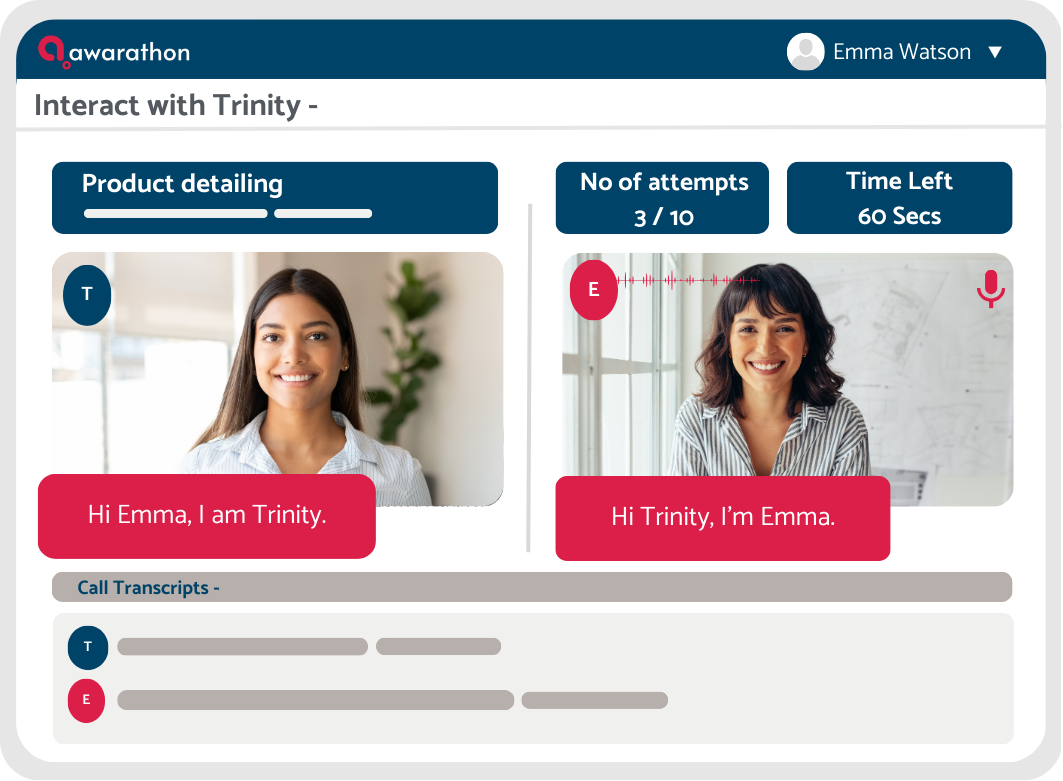
Trinity: The AI Persona Leading the Charge
Traditional AI applications in insurance have primarily focused on data analysis and automation. While these applications are invaluable, they often lack the interactive element crucial for effective sales training. AI roleplay, on the other hand, emphasizes both dynamic simulations and real-world practice along with analytics. A prime example of this is Trinity, an AI persona developed by Awarathon. Designed specifically for sales training and customer interaction simulations, Trinity possesses advanced AI capabilities that allow it to accurately mimic human behaviour and responses. This creates a realistic and immersive training environment for insurance professionals, helping agents develop the skills and confidence needed to handle a wide range of customer interactions effectively.
How AI-Enabled Sales training is revolutionizing insurance sales:
Improvement in Product Knowledge for Better Handling of Claims:
- Enhanced Expertise: Trinity provides agents with comprehensive, up-to-date product information through realistic simulations.
- Accurate Claims Handling: By practising with Trinity, agents can better understand product nuances, leading to efficient claim resolutions and increased customer trust.
Increase in Customer Retention:
- Personalized Interactions: Trinity helps agents practice tailored communication strategies by simulating diverse customer needs.
- Stronger Relationships: Training with Trinity improves agents' ability to handle inquiries and issues promptly, boosting customer loyalty.
Upselling and Cross-Selling
- Effective Sales Techniques: Trinity presents various sales scenarios, allowing agents to perfect their upselling and cross-selling techniques.
- Increased Sales: Real-time feedback from Trinity helps agents identify and offer additional products that meet customer needs.
Building Rapport with Customers
- Improved Soft Skills: Trinity aids agents in developing active listening and empathy through interactive roleplay.
- Efficient Interactions: By practising with Trinity, agents gain confidence in delivering value propositions, leading to meaningful, shorter engagements.
AI-enabled sales training with personas like Trinity equips agents with essential knowledge, skills, and confidence, resulting in better customer interactions, higher sales, and increased customer loyalty. This technological advancement is a strategic imperative for the future of insurance sales.